

Seattle Musicians: Protect Your Hearing While You Can
Seattle runs on music. On any given night in October you can hear as symphony at Benaroya Hall, a jazz quartet in a basement club, a punk show on Capitol Hill, or a church choir rehearsing down the street. The people making that music are relying on one thing more than any instrument: their ears.
Hearing damage from sound exposure is often permanent, and it usually happens so gradually that musician’s don’t notice it happening. A note that sounds slightly off. Cymbals that seem duller than they used to. A ringing that doesn’t fade after the gig.
The good news: it is almost entirely preventable. That’s why, on Monday October 26th, (the day after Earshot Jazz festival wraps), Harmony Audiology is offering baseline hearing screenings and hearing preservation consultations for Seattle-area musicians and music industry workers as part of National Audiology Awareness Month. Details are below. But first, here’s why it matters.
WHY MUSICIANS ARE AT HIGHER RISK
Musicians don't just attend loud events. They create them, for hours at a time, often with the sound source inches from their ears. One large German study (Schink et al., 2014) found that professional musicians were nearly four times as likely to develop noise induced hearing loss as the general population, and more likely to develop tinnitus.
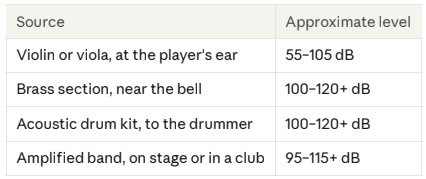
Approximate sound levels musicians commonly face:
How long you're exposed matters as much as how loud. Under the occupational guidelines from the National Institute for Occupational Safety and Health (NIOSH), 85 dBA is considered safe for 8 hours. Every 3 dB increase cuts that safe time in half.
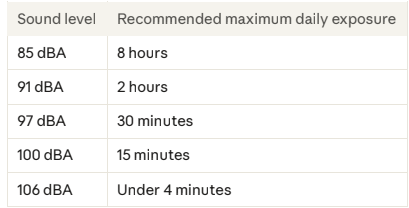
NIOSH Noise Dosage Chart
Now add it up: daily practice, weekly rehearsals, a few gigs, teaching lessons, and listening on headphones on the bus. Many working musicians exceed their safe daily dose before the downbeat of the show.
And it isn't only players. Sound engineers, venue staff, bartenders, DJs, and music teachers spend just as many hours in the same rooms.
HEARING PROTECTION THAT ACTUALLY WORKS FOR MUSICIANS
Most musicians who skip hearing protection have the same reason: foam earplugs make music sound terrible. They cut the high frequencies far more than the lows, so everything sounds muffled and boomy. It's hard to hear your tone, your intonation, or the rest of the band.
That's a real problem, and there's a real solution.
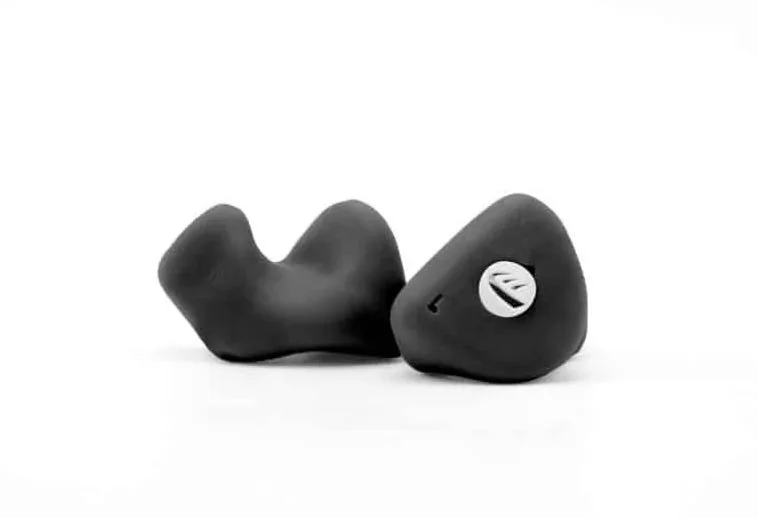
Custom Musician’s Earplugs
These plugs use a filter that lowers sound evenly across frequencies. The music sounds the same, only quieter. Filters come in different strengths (commonly 9, 15, or 25 dB), so a string player in a quiet chamber group and a drummer in a rock band can each get the right amount of protection. Because they're molded to your ears, they're comfortable for a full rehearsal or a three-set night.
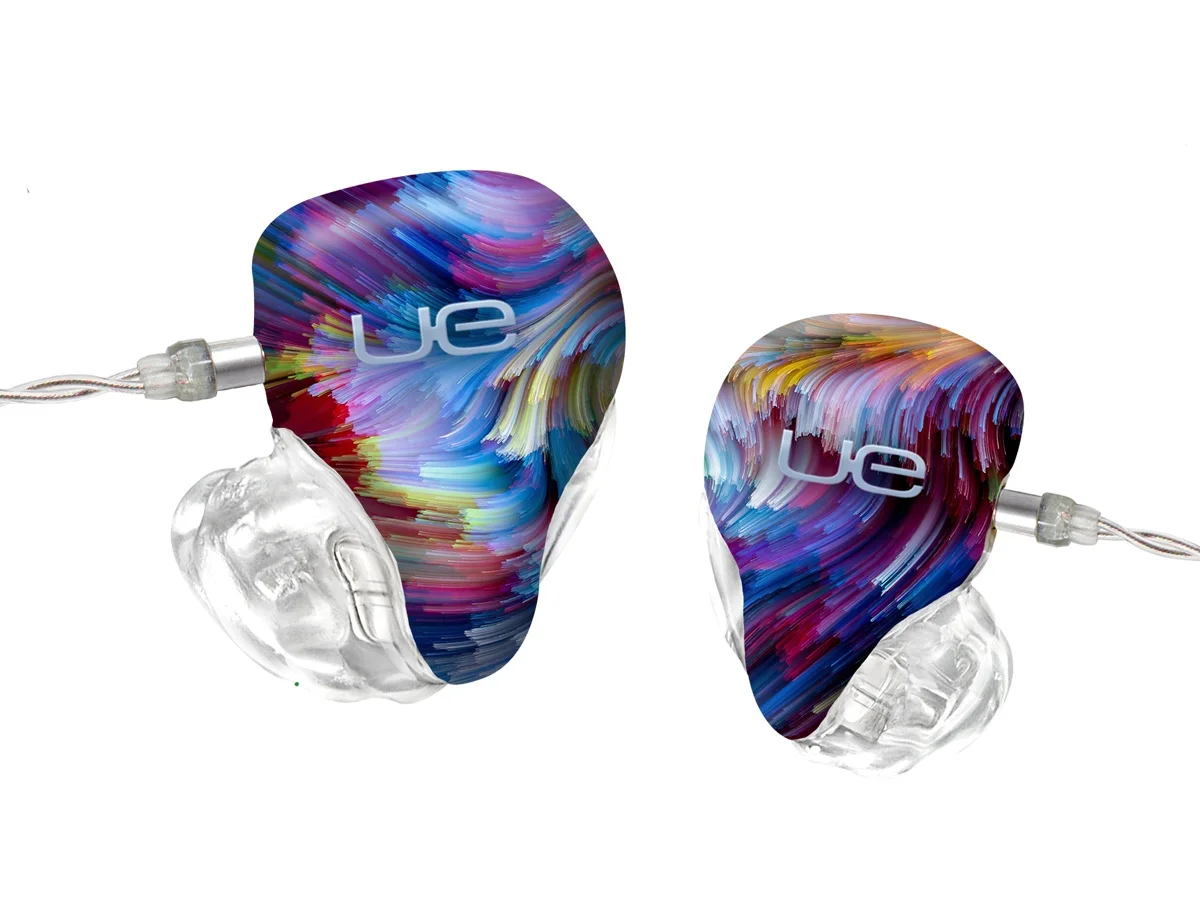
Custom in-ear monitors
These can give performers a clean, controlled mix at a safer volume, instead of competing with loud stage wedges.
Also consider these smart habits, they add up too!
Give your ears quiet breaks between rehearsals and gigs
Rethink stage setup, such as risers for brass and space between players and amps
Keep headphone listening at or below 60% volume
Use a free sound level meter app to check your practice room and venues
Treat ringing or muffled hearing after a show as a warning sign, not a normal part of the job.
WHY EVERY MUSICIAN NEEDS A BASELINE HEARING TEST
A baseline hearing evaluation is a snapshot of your hearing . On its own, it tells you where you stand. Over time, it becomes something more valuable: a reference point that lets an audiologist spot small changes before they turn into permanent problems you can hear.
Without a baseline, there's nothing to compare against. A future test might show mild hearing loss, but no one can say whether it's new, how fast it's progressing, or whether your protection plan is working.
For musicians, a thorough baseline can include:
Standard hearing testing across the frequencies used for speech
Extended high-frequency testing, above the range of a standard test. Noise damage often shows up here first, so it may reveal early changes before they affect the range you notice.
Distortion product Otoacoustic Emissions (DPOAEs), a quick, painless look at the delicate hair cells of the inner ear (more on this below).
Speech-in-noise testing, which shows how well you understand speech in a noisy environment like a crowded venue.
Tinnitus and sound sensitivity check-in, so any ringing or discomfort is documented from the start
DPOAEs AND THE EARLIEST SIGNS OF WEAR AND TEAR
Deep inside your inner ear are thousands of tiny outer hair cells. They act like a built-in amplifier, fine-tuning sound so you can hear soft notes, subtle overtones, and the difference between similar pitches. They're also among the most delicate structures in the hearing system, and among the first to be affected by loud sound. Audiologists measure DPOAEs (distortion product otoacoustic emissions) to evaluate these microscopic structures.
Here's the remarkable part: healthy outer hair cells don't just respond to sound, they produce a faint sound of their own. During DPOAE testing, a small soft probe in the ear canal plays two tones at once. When the outer hair cells are working well, they send back a tiny echo, called a distortion product, which a sensitive microphone picks up and measures across a range of pitches.
Why do DPOAEs matter so much for musicians?
They can reveal early changes.
Research suggests DPOAE results can show signs of strain on the inner ear before a change appears on a standard hearing test. That gives you a chance to adjust your protection plan while the damage is still small. It's pitch-specific. We can see which regions of the inner ear are responding strongly and which may be showing early wear, which often lines up with the pitches where noise does its damage first.
They are objective.
You don't have to listen for beeps or press a button. The test measures how your inner ear responds on its own, and it takes just a few minutes. It makes your baseline more powerful. Comparing DPOAE results from year to year adds a sensitive early-warning layer to your hearing monitoring.
We recommend a baseline for any musician who plays regularly, especially for anyone who is:
starting a music degree or a professional career
playing drums, brass, or in amplified or electronic music
working as a sound engineer, venue worker, or music teacher
noticing ringing, muffled hearing or discomfort after playing
After your baseline, regular monitoring (often once a year for active musicians) lets you track your hearing the way you’d maintain any other instrument.
Hearing Screenings and Ask-An-Audiologist Event at Harmony Audiology in Mountlake Terrace
To celebrate National Audiology Awareness Month, Harmony Audiology is opening its doors to Seattle's music community for events dedicated to raising awareness about hearing preservation and hazards related to musicianship.
When?
Monday, October 26th 2026 9am-5pm
Tuesday, November 17, 2026 9am-5pm
Where?
Harmony Audiology
21907 64th Ave W, Suite 100, Mountlake Terrace WA 98043
Who?
Musicians, music students, sound engineers, venue staff, DJs, music teachers, and anyone who works or plays around live sound.
Cost?
FREE
How to Book?
Text or call 206-880-7333
Spots are limited!
A SPECIAL OFFER
Custom molded filtered earplugs are 20% off for orders placed during this event!
Your free hearing screening (a simple 10 minute test) gives you a quick look at where your hearing stands today. You'll leave with your results and a clear explanation of what they mean. If anything stands out, we'll talk through whether a full diagnostic evaluation and baseline makes sense.
Your free hearing preservation consultation is a one-on-one conversation with an audiologist about your instrument, your rehearsal and gig schedule, and the rooms you play in. You'll leave with:
a personalized plan to protect your hearing
guidance on custom musician’s earplugs and in-ear monitors, including which filter strength fits your situation
recommendations for how often to monitor your hearing going forward
answers to your questions about tinnitus, sound sensitivity, or changes you’ve noticed
Protect the instrument you can’t replace!
You can replace strings, reeds, and drumheads. You could even replace your instrument, if you had to, god forbid. Your hearing is the one piece of gear you get for life.
Whether you're a symphony player, a weekend gigging guitarist, a music student, or the person behind the soundboard, a hearing screening or free consultation is an easy first step. Bring your questions- and a bandmate while you're at it!
Book your free baseline screening and hearing preservation consultation: Text or call 206-880-7333.
Harmony Audiology provides specialized, evidence-based hearing care for musicians, music industry professionals, and anyone living with tinnitus, sound sensitivity, or hearing loss.
